Most Roadworthy Fails Cost About Twenty Dollars to Prevent
Ask what fails a roadworthy and people picture a cracked chassis. That is almost never it.
What fails cars is a number plate globe, a wiper blade that smears instead of clears, and a tyre sitting a millimetre under the limit. Two dollars, twelve dollars, and a tyre you were going to replace anyway. All three are cheap on a Saturday morning in your driveway and all three cost you a re-inspection if you leave them to us to find.
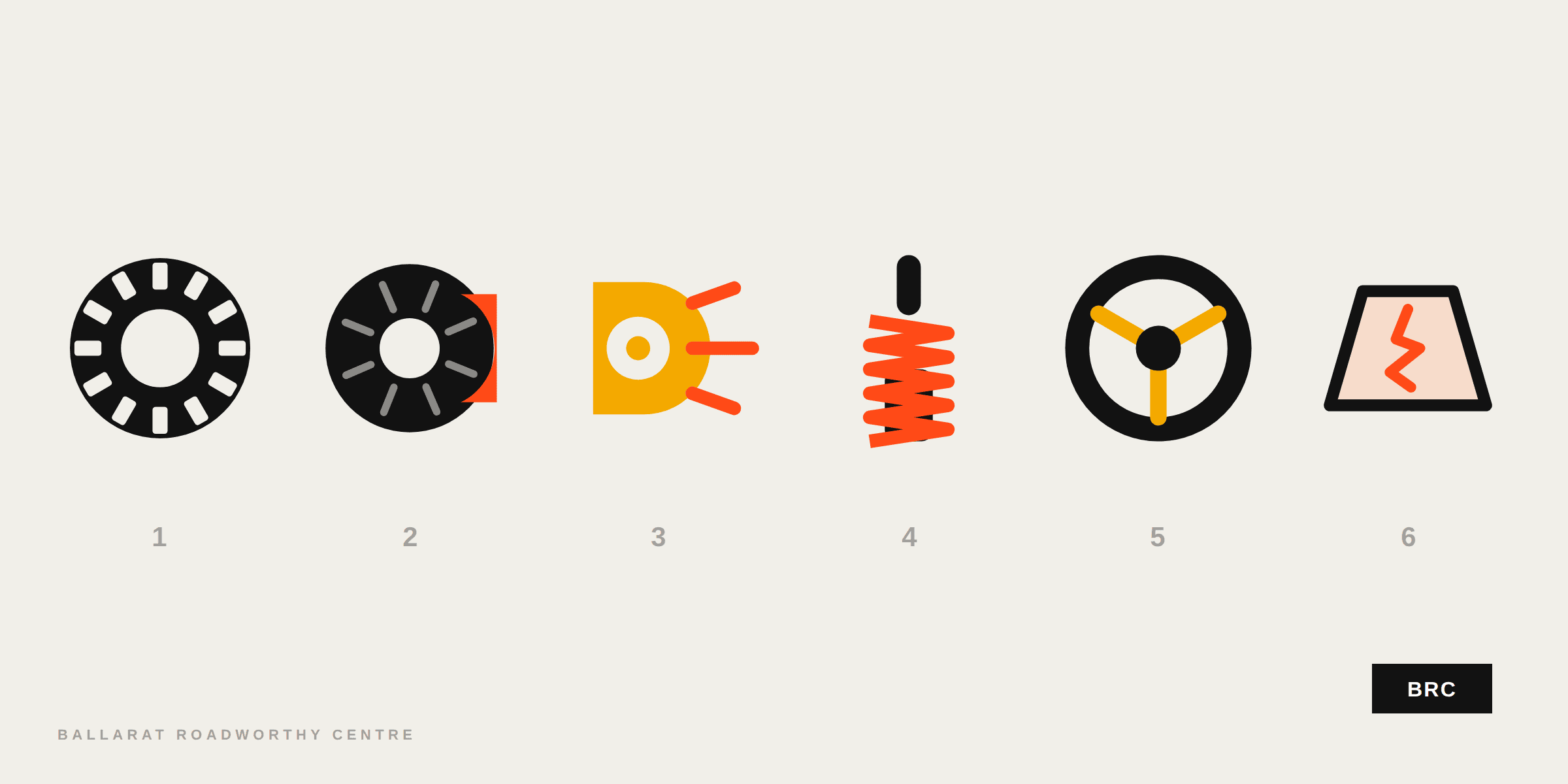
Ballarat Roadworthy Centre has been testing cars for more than twenty years and the same six things account for most of what we knock back. Here they are, roughly in order of how often they come up.
1. Tyres, and you can check these yourself
The Victorian minimum is 1.5mm of tread across the face of the tyre. Under that is a fail, and so is sidewall damage, a bulge, or any exposed cord.
Look inside the tread grooves for the small raised bars moulded into them. If the tread has worn down level with those bars, the tyre is finished, and no amount of hoping will change that on the day.
The one people miss is uneven wear. A tyre with plenty of tread on the outside edge and nothing on the inside will still fail, and it's also telling you the alignment or a suspension component has gone. Check all four, and check the spare if it's a full-size one.
2. Lights, also yours to check
Every exterior light has to work. High beam, low beam, park lights, indicators front and rear, brake lights, tail lights, reverse lights, and the number plate light that everyone forgets exists. Headlight aim gets checked too.
Get someone to stand outside the car while you work through the lot. It takes four minutes. The number of cars we fail on a blown globe is genuinely irritating, because it's the cheapest part on the vehicle and the owner is the only person who could have caught it.
If one goes while the car's here we'll put a globe in rather than fail you over it. But you shouldn't need us for that.
3. Brakes, where you'll want us
A roadworthy asks more than whether the car stops. Pads get measured against the manufacturer's minimum, discs get checked for thickness, scoring and lip, and the fluid gets checked for condition. Old, dark, moisture-loaded fluid can fail a car whose pads and discs are perfectly fine.
Here the car also goes on the brake roller tester, which reads the braking force at each wheel separately. A brake that's dragging, or one side doing noticeably less work than the other, shows up as a number instead of a feeling. That's the difference between a roadworthy that measures and one that has a guess.
If the brakes are already due, get them done before the inspection. Paying for the test twice is a poor way to save money.
These guys stick to the rules for RWC which is commendable for this industry.
Melissa, Google review
We take that as the compliment it was meant to be. The rules are the product.
4. Suspension
Shock absorbers get checked for leaks and damping. Ball joints, control arm bushes and sway bar links get checked for movement and perishing.
Worn suspension almost never announces itself. The car keeps driving, just slightly worse every month, which is why kilometres and age are a better guide than how it feels to you. Clunks over the speed humps, a nose that dives hard under braking, or those unevenly worn tyres from section one are all worth getting looked at before you book rather than after.
5. Steering
Play at the wheel gets measured against the allowable limit, then the rack, tie rod ends and linkages get checked for wear and leaks. Some movement is normal. Past the limit is a fail.
This is the one you genuinely can't assess in your driveway. If the wheel feels vaguer than it used to, or you're making more small corrections on the Western Freeway than you remember making, get it looked at first.
6. Windscreen and wipers, back to you again
Where the damage sits decides how strictly it's judged. A chip or crack directly in the driver's line of sight is treated far more seriously than the same damage out near the edge. A crack that's actively spreading fails wherever it is.
Wipers and washers count as well. Blades that streak, chatter or lift off the glass are a fail, and so are washers that don't reach the windscreen. A chip repair costs a fraction of a new screen, so if you've been meaning to get one done, do it before the crack runs across the glass and the decision gets made for you.
If you fail anyway
It isn't a disaster. In most cases you can drive the car away and sort the repairs out, unless the fault is serious enough to make it unsafe, and the tester will tell you straight if that's the case.
You'll get a written list of exactly what failed. Small stuff gets handled here on the spot. Anything bigger we price for you, and you choose whether we do it or someone else does. Bring the car back within 14 days and we only re-check the failed items. Leave it past 14 days and it's a fresh inspection at full price, which is worth knowing before the fortnight quietly gets away from you.
Once it passes, the certificate is good for 30 days.
Do the driveway check, then book
Walk around the car with someone on the brake pedal, check every light and every tyre, then ring 03 5335 8920 or book online. If you already know the brakes or the steering are marginal, say so when you book and we'll look at those first.
📍 35 Martin Drive, Delacombe VIC 3356
🕒 Monday to Friday 8:00am to 5:00pm
⭐ 4.6 Stars with 250+ Google Reviews